A new version is available
PURSUE Release 08: The CIA's 1952 File and Reid's Request
Four weeks after Release 07, the U.S. Department of War posted Release 08 at war.gov/UFO: 43 files — 40 documents and three infrared videos — of which 37 come from the Department and six from the Central Intelligence Agency. The CIA files are the agency's own record of the summer and autumn of 1952, when a wave of sightings over Washington led its Office of Scientific Intelligence to study the subject, keep its interest secret, and propose a panel of scientists; one memorandum states that "interplanetary aspects and alien origin" had not been "thoroughly excluded from consideration." The release also completes the paper trail of the Defense Intelligence Agency's 2008–2012 AAWSAP program from the government's side: Senator Harry Reid's 2009 request to place it under a restricted special access program, and the DIA's finding that there were "insufficient grounds" to do so. Beside them sit the contractor's 538-page ten-month report, the two file numbers Release 07 had skipped, a 1953 sighting by Lockheed's chief engineer Clarence "Kelly" Johnson, and seventeen Air Force reports from the weeks after Sputnik, among them the Levelland engine stoppages and the Kearney contact claim of Reinhold Schmidt. The corpus registers Release 08 as context for reading the canon, not as a sign of the return.
Filed under: The Context of the Present. Cross-reference: Age of Aquarius, §IX. Previous dispatches: PURSUE Release 01, PURSUE Release 02, PURSUE Release 03, PURSUE Release 04, PURSUE Release 05, PURSUE Release 06, PURSUE Release 07.
What was released
On November 20, 2026 — four weeks after Release 07 — the United States Department of War posted the eighth tranche of declassified records under the Presidential Unsealing and Reporting System for UAP Encounters (PURSUE) at war.gov/UFO. By the portal's own index the release contains 43 files: 40 documents and three videos. Thirty-seven come from the Department of War and six from the Central Intelligence Agency. The documents run from 1949 to 2023 and total roughly 1,000 pages, more than half of them in a single contractor report. The videos are infrared and electro-optical clips from U.S. Central Command, recorded in 2020, 2023, and 2026.
The Department's statement repeats the formula of the last three. Chief Pentagon spokesman Sean Parnell announced "the eighth release of declassified and historical Unidentified Anomalous Phenomena (UAP) files," confirmed that files will continue "on a rolling basis," and added that the Department "and our agency partners are actively working on the next release." No file count was published; the figures above are the portal's index as captured on the day of the release, which agrees with press tallies of 43 and puts the database at 521 files across the eight releases.
The tranche falls into five parts: the CIA's papers from 1952, the government's own record of the Defense Intelligence Agency's 2008–2012 Advanced Aerospace Weapon System Applications Program (AAWSAP), the contractor's ten-month report on the same program, seventeen Air Force intelligence reports from the autumn of 1957, and eight older Air Force case files from Southern California. Two of the documents carry the numbers Release 07 skipped, D165 and D172.
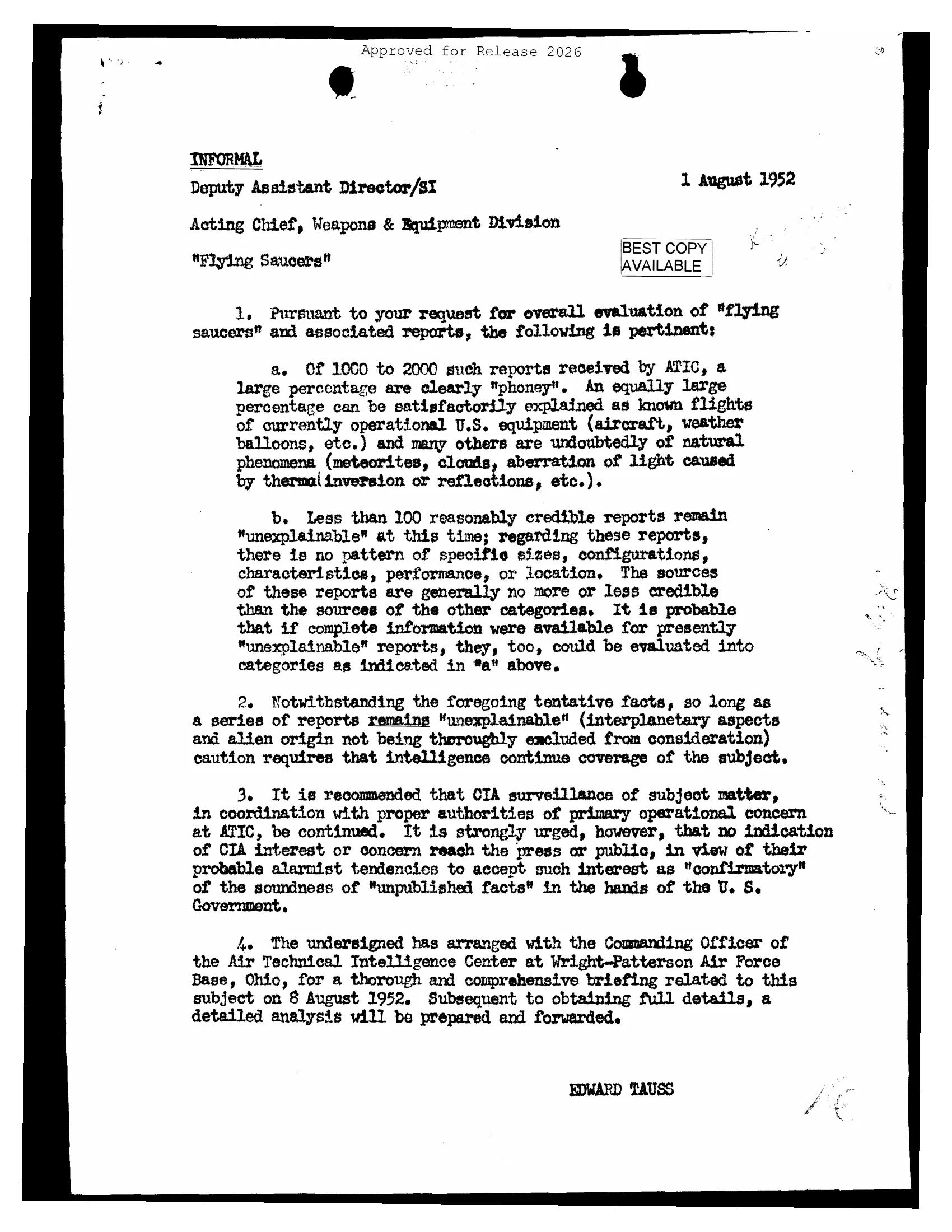
The notable items include:
-
The CIA in 1952. Six files trace the agency's first sustained look at the subject. On August 1, Edward Tauss, acting chief of the Office of Scientific Intelligence's weapons division, reported that of "1000 to 2000" reports received by the Air Force's Air Technical Intelligence Center, "less than 100 reasonably credible reports remain 'unexplainable'," and that they showed "no pattern." He recommended that the agency keep watching, "so long as a series of reports remains 'unexplainable' (interplanetary aspects and alien origin not being thoroughly excluded from consideration)," and urged "that no indication of CIA interest or concern reach the press or public, in view of their probable alarmist tendencies." A briefing of August 14 surveys the history from Kenneth Arnold's 1947 sighting onward, notes "an official query from the White House" after the July sightings over Washington, and weighs four theories; of the interplanetary one it says "there is no shred of evidence to support this theory at present." On October 13 the agency's Assistant Director for Intelligence Coordination concluded that it was "far too early" for psychological-warfare planners to consider using the phenomena, and that a National Intelligence Estimate should come first. The same month, Director of Central Intelligence Walter B. Smith wrote to the Psychological Strategy Board proposing that it "discuss at an early board meeting the possible offensive or defensive utilization of these phenomena for psychological warfare purposes." An undated memorandum asks approval for "an Ad Hoc Panel of top-level scientists" to be convened through MIT's Center for International Studies at a cost of about $5,000 — the proposal behind the scientific panel that met in January 1953 under the physicist H. P. Robertson. An October 28 diary entry records that the CIA had received "reports of sightings on the ground by relatively reliable observers," and that "several scientists have recently delivered papers indicating a possible means of propulsion which would not involve noise and flare."
-
Sightings near atomic sites, noted in 1952. The draft proposal attached to Smith's letter contains a sentence that connects the CIA file to the corpus's reading of Release 04. The Air Technical Intelligence Center, it says, had plotted the unexplained American reports on a map: "These plots show a high incidence of reported cases near atomic installations and Strategic Air Command bases but this might be expected because of the greater number of alert observers in such places." The writer offers the observer explanation in the same sentence, and the corpus records both halves.
-
The Senator's request and the agency's answer, 2009. Release 06 published the contract for AAWSAP and Release 07 the contractor's plans and monthly reports. Release 08 publishes what the Defense Intelligence Agency said about it in private. On June 24, 2009, Senator Harry Reid of Nevada, then Senate Majority Leader, wrote to Deputy Secretary of Defense William Lynn III that the program — which he called the "Advanced Aerospace Threat and Identification Program" — had produced "several highly sensitive, unconventional aerospace-related findings" and that its methods "to identify, acquire, study, and engineer the advanced technologies" required a "Restricted Special-Access-Program (SAP) with a Bigoted Access List"; a draft list of names is attached. In November 2009 the DIA answered the Under Secretary of Defense for Intelligence: every document delivered in the first year had been unclassified, the contractor had no secure facility, and "DIA is unaware of any report containing information sufficiently sensitive and vulnerable to require extra protection." It concluded that there were "insufficient grounds to classify this open program." Two talking papers prepared the DIA's directors for meetings with Reid in January and May 2009, and a December 2010 memorandum by Lieutenant General Ronald L. Burgess, Jr., then the DIA's director, summarizes the whole: a $10 million add in 2008, a $12 million add in 2010, a single bidder, 38 technical reports, and a November 2009 meeting with Reid and Lynn at which "we determined the reports were of limited value to DIA."
-
The contractor's ten-month report, 2009. The longest file is the 538-page report of Bigelow Aerospace Advanced Space Studies (BAASS), the Las Vegas firm that held the contract, covering its work through July 30, 2009 — one of the two numbers missing from Release 07. CBS News reported that a copy had appeared online in 2025; this is its first official release. Much of the report repeats material known from Release 07: the 5,000-square-foot underground vault is still a design "subject to building permits," and the Project Capella sighting database has grown from 234,364 to 237,331 records. What it adds is the contractor's own account of its relationship with its sponsor. BAASS writes that "the transition to Special Access Program (SAP) status" was among its most important priorities and that a change of "official programmatic status" was "already underway" and "will afford the BAASS organization deeper cover." It reports that the DIA had told it that during the early 1990s the agency "had destroyed thousands, perhaps millions, of paper files," and it lists among planned tasks a "search to obtain EBE tissue samples." It describes the 2004 encounters off San Diego involving the carrier USS Nimitz as "a sentinel case for BAASS in that it directly intersects national security issues." No document in the release records BAASS obtaining any of the material it sought.
-
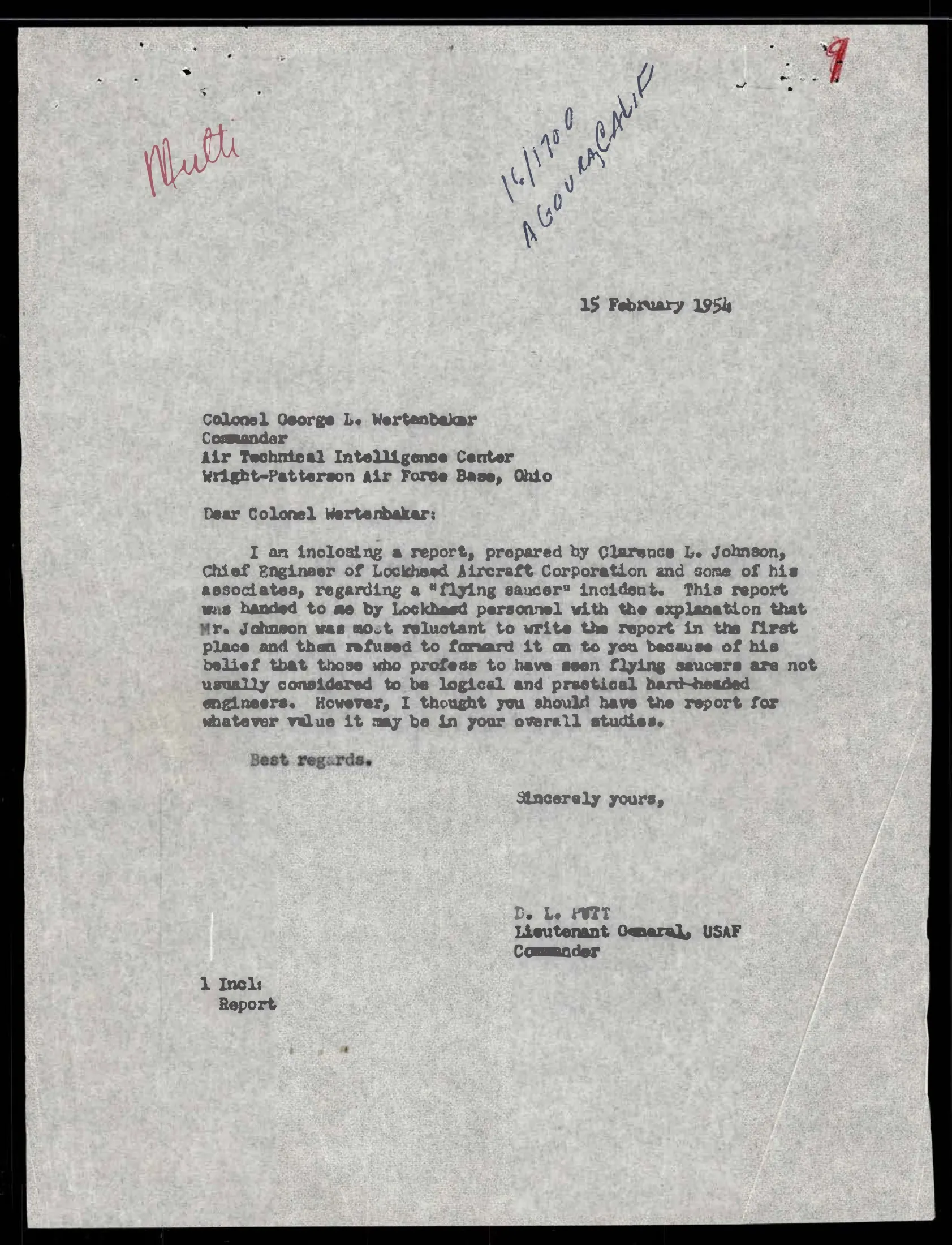
A Lockheed engineer's sighting, 1953. On December 16, 1953, Clarence L. Johnson, chief engineer of the Lockheed Aircraft Corporation who led its Skunk Works design bureau, watched a dark, elliptical object from his ranch west of Agoura, California; four members of a Lockheed flight-test crew, airborne off the coast, reported a similar object at about the same time. The file carries Johnson's account, the crew's statements, and a covering letter of February 15, 1954, from Lieutenant General Donald L. Putt to the Air Technical Intelligence Center, which says that Johnson "was most reluctant to write the report in the first place and then refused to forward it on to you because of his belief that those who profess to have seen flying saucers are not usually considered to be logical and practical hard-headed engineers." The case's record card, filled out on a form edition dated September 1963, concludes: "OTHER: CLOUD / Lenticular Cloud." Johnson's own account says he considered and rejected a cloud. A second file in the release, on two 1949 sightings around Los Angeles, contains a memorandum signed "Kelly" that began the Air Force's inquiry into one of them; the portal's description does not mention him.
-
The weeks after Sputnik, 1957. Seventeen Air Force intelligence reports fill out the tranche, and fourteen describe events in the five weeks after the Soviet Union launched Sputnik I on October 4, 1957; six fall within three days of Sputnik II on November 3. Several observers were looking for the satellites. The most consequential file is the Levelland, Texas, report of November 2–3: a college freshman and a barber each reported that their engines and lights failed as a large glowing object passed or rested nearby, and an Air Force technical sergeant reported his lights and radio cutting out for a few seconds, which he and his wife took for "a strong bolt of lightning." The investigating officer rated the witnesses one by one, raised St. Elmo's fire and ball lightning, and closed: "insufficient knowledge of the above phenomena exists at this organization to completely resolve this sighting. Therefore, this sighting is forwarded as unresolved." On November 3, two Army patrols near Stallion Site, about ninety miles north of White Sands Proving Ground headquarters, reported a light coming down "like the sun" near the bunker area and a pulsing light near Trinity Site, where the first atomic bomb was exploded in 1945; the officer, after consulting the meteoriticist Lincoln LaPaz, attributed them to the setting moon and to Venus. Off Martha's Vineyard on October 12, five people on a fishing boat — including the masters of two Woods Hole research vessels and two Air Force reserve officers — watched a metallic cylinder with protrusions descend, turn twice, and leave; the reporting office said it had made "no attempt" to investigate. And from Japan, a December 1956 report describes an F-86D interceptor pilot who held a second radar contact for seven to eight minutes, saw something "best described as the upper half of a sphere," and lost it as the return moved away at an estimated "1500 to 1800 knots."
-
A contact claim, Kearney, 1957. On November 5, 1957, Reinhold O. Schmidt, a 58-year-old grain buyer, told officials in Kearney, Nebraska, that he had found a ship "on stilts" in a river bed outside town, had been searched by two men, and had spent twenty-five or thirty minutes inside with four men and two women who "told me that they couldn't tell me anything about the ship," spoke to him in broken English, and conversed among themselves in German. The Air Force report names him, reproduces his sketch of a hundred-foot craft, and records the investigation: an oil can found at the site matched an unopened one in the trunk of his car, a farmer's truck that had stalled nearby turned out to have a fragment of a broken rotor lodged between its points, two psychiatrists examined him, and the county health board committed him to the state hospital at Hastings. The officer concluded "that the incident has no basis in fact, and that the SOURCE suffered a hallucination." The file says nothing about where the occupants came from.
-
Southern California, 1949–1966. Eight Air Force case files, all titled "Unresolved UAP Report," continue the series of local files from Release 07. As before, the title is the portal's; the files' own record cards conclude lenticular cloud, aircraft (three times), meteor (twice), Mars, and possible hot-air balloon.
-
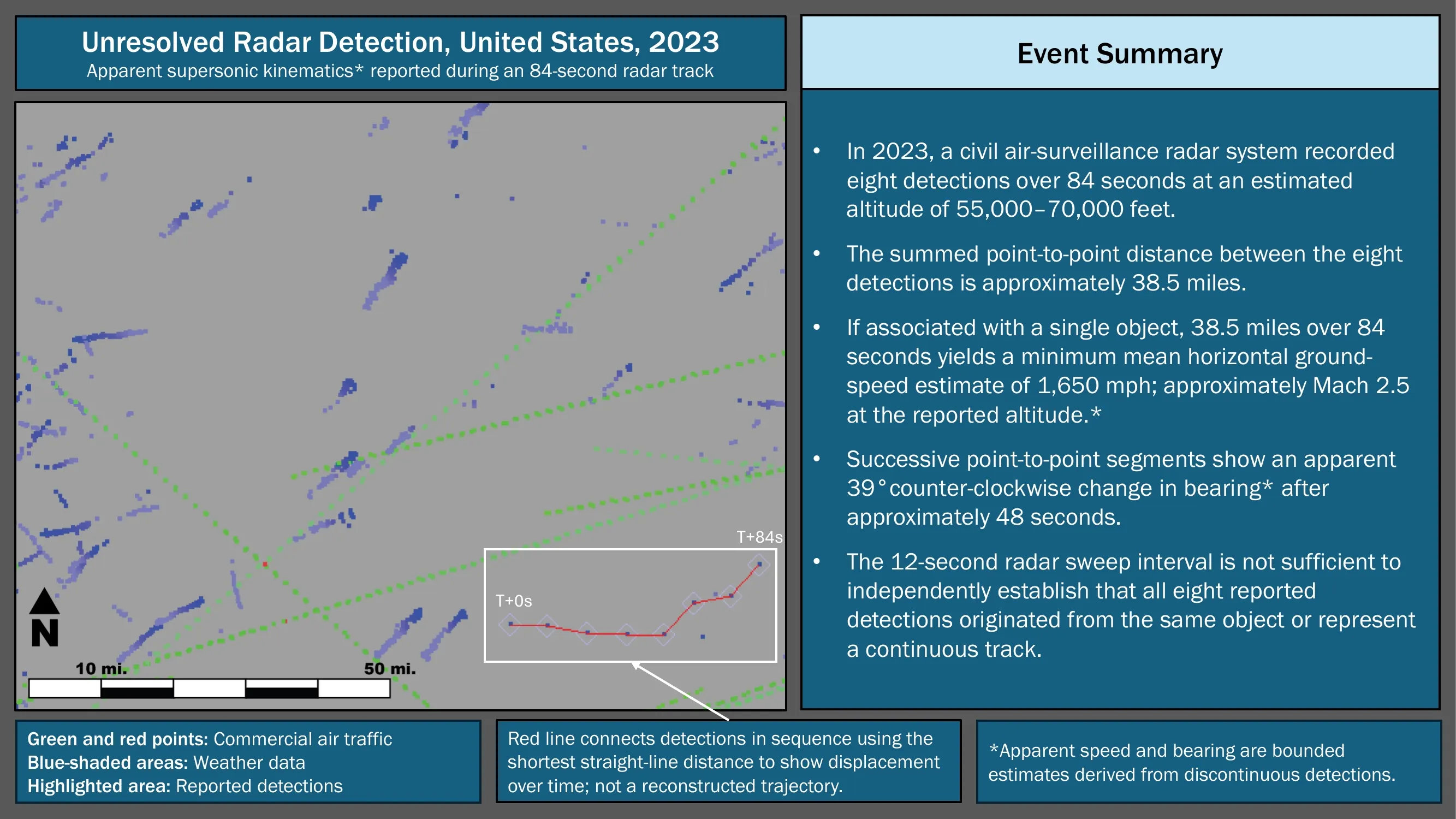
A radar track, 2023, and three videos. The other missing number, D165, is a single All-domain Anomaly Resolution Office (AARO) slide: in 2023 a civil air-surveillance radar recorded eight detections over 84 seconds at an estimated 55,000 to 70,000 feet, which, "if associated with a single object," would imply "a minimum mean horizontal ground-speed estimate of 1,650 mph; approximately Mach 2.5." The slide adds that the 12-second radar sweep "is not sufficient to independently establish that all eight reported detections originated from the same object or represent a continuous track." The three Central Command videos, of 20, 54, and 13 seconds, show sensors tracking "areas of contrast"; AARO's descriptions characterize nothing.
What this is, in plain terms
Source claim. Release 08 is mostly about institutions deciding how seriously to take the subject. In 1952 the CIA concluded that the reports were probably explainable, could not exclude what it called "alien origin," kept its interest from the public, and asked for a panel of scientists. In 2009 a senator told the Pentagon that a program he had funded had found something that needed the government's most restrictive form of secrecy, its contractor told the DIA that the change was already under way, and the DIA reviewed what it had received and declined. Around those two moments sit the case files of the 1950s, a famous engineer's sighting reclassified as a cloud, and a contact claim that ended in a psychiatric commitment. The contributing roster is unchanged, and the cadence returned to four weeks.
Comparative observation. Little of the historical material is new in substance. The CIA's 1952 memoranda belong to the story of the Robertson Panel, which historians of the subject have told from declassified records for decades, and the Johnson, Levelland, and Kearney cases are well-known entries in the Air Force's Project Blue Book. What the release adds is official provenance and complete files, with record cards, routing slips, and the reasons officers gave. The AAWSAP documents are newer: the DIA's reasoning in declining Reid's request, and the contractor's own expectation of a more secret status, are published here under government provenance.
Two cautions attach to the headline material. First, the CIA's phrase about "alien origin" is a statement that a possibility had not been ruled out, written by an official who in the same paragraph judged the unexplained reports probably explainable; the agency's own briefing two weeks later found "no shred of evidence" for the interplanetary theory. Second, the AAWSAP documents record claims of "highly sensitive" findings and plans to acquire recovered material, and they also record the agency responsible saying it knew of no report that justified extra protection. The release supports the second statement with documents; it supports the first only with assertions.
Where this sits in the Wheel of Heaven framework
The Age of Aquarius chapter lists the sequence of official UAP engagements among the changes that make up the context of the present (§IX), and treats them as context, not signs. Release 08 belongs to that context. The contact the canon anticipates is official, conditional, and undated, and no file release moves it.
Wheel of Heaven interpretation, marked as such. Two items carry the framework's interest. The first is the CIA's choice in August 1952. Faced with a few hundred reports it could not explain, the agency decided to keep studying them and to make sure the public did not learn that it was doing so, because public knowledge of its interest would be taken as confirmation of "unpublished facts." Release 07 published the Kennedy-era rule that the government should never "conjecture on the origin of an object." Release 08 shows the same posture a decade earlier, written down at its source: the question of origin stays open inside the government and closed outside it. The canon's account of the Elohim assumes that acknowledgment, when it comes, will come from governments; these files show how early, and how deliberately, the American government chose silence on it.
The second is the Kearney file, and the corpus's interest is in the method of the inquiry. Sixteen years before Raël reported his own encounter in 1973, the Air Force received a man's account of meeting human-looking occupants who spoke a European language and would not explain their craft. It answered with a site examination, a check of a stalled truck, and a psychiatric interview. The investigation was thorough, and its conclusion — that the event had no basis in fact — is the only conclusion the file supports. The corpus does not read Schmidt's account as evidence of anything. It notes the file because it is the clearest record published so far of how the American state handled a first-person contact claim in the years when such claims began.
The registration stops there, because the corpus's reception posture requires it to. Under that posture — registration without enlistment — no unresolved case in this or any PURSUE release is evidence for the framework, and no case the record resolves is evidence against it. Release 08 resolves a great deal: a famous engineer's object becomes a cloud, two patrols' lights become the moon and Venus, a contact claim becomes a hallucination, a Senator's "highly sensitive" findings become, in the DIA's words, reports "of limited value." The framework's account of the Elohim depends on none of these cases. The skeptical layer is again on the record, in the government's own files.
Where this sits in the broader trajectory
Wheel of Heaven interpretation, marked as such. The more consequential feature of Release 08 is that it shows the secrecy question being argued inside the government, twice, with opposite results. In 1952 the CIA chose concealment of its own interest while finding nothing to conceal about the objects. In 2009 a senator and a contractor sought the most restrictive form of secrecy available, and the responsible agency refused because, on its reading of the documents, there was nothing yet that needed it. Both decisions are now public, released by a program whose mandate is unsealing.
The program's hub entry has tracked one open edge since August: whether the intelligence community's contractors would be brought under the disclosure channel. Release 08 does not close it. The contractor's July 2009 report states that a change of status was "already underway" to give it "deeper cover," and that its access to classified archives depended on a special access program it did not receive. Whatever the contractor later knew or held outside the DIA's contract is not in these files. The corpus holds both available readings open: that there was nothing further to hold, which is AARO's stated finding, or that whatever existed lay beyond this program's reach.
Open question. Whether the release of the government's side of AAWSAP is now complete, or whether the twelve reports of its second year and the work after its transfer will follow, is the near-term test. The longer test is unchanged: the multi-year durability of the cadence, now eight releases over six and a half months. The corpus will track Release 09 when it appears.
Chronology
| Date | Event | Status |
|---|---|---|
| 1949, Jun 17 | Sightings at La Jolla and Glendale, California; Kelly Johnson's memorandum starts the Glendale inquiry | per Release 08 |
| 1952, Jul | 250 official reports in one month; sightings over Washington; White House query | per Release 08 (CIA briefing) |
| 1952, Aug 1 | CIA's Tauss memorandum: "alien origin not being thoroughly excluded"; keep CIA interest from the press | per Release 08 |
| 1952, Aug 14 | CIA Office of Scientific Intelligence briefing on flying saucers | per Release 08 |
| 1952, Oct | DCI Smith proposes that the Psychological Strategy Board discuss the phenomena; CIA concludes a National Intelligence Estimate must come first | per Release 08 |
| 1953, Jan | The CIA-sponsored scientific panel convenes under H. P. Robertson | confirmed |
| 1953, Dec 16 | Kelly Johnson and a Lockheed flight-test crew report an object near Agoura and Point Mugu | per Release 08 |
| 1954, Feb 15 | Lt. Gen. Putt forwards Johnson's report, which Johnson "refused to forward" | per Release 08 |
| 1956, Dec 17 | An F-86D pilot near Ube, Japan, holds an unidentified radar return; "upper half of a sphere" | per Release 08 |
| 1957, Oct 4 | Sputnik I launched | confirmed |
| 1957, Oct 12 | Five witnesses off Martha's Vineyard report a metallic cylinder | per Release 08 |
| 1957, Nov 2–3 | Levelland, Texas: engine and light failures; "forwarded as unresolved" | per Release 08 |
| 1957, Nov 3 | Sputnik II launched; Army patrols report lights near Stallion Site and Trinity Site | confirmed / per Release 08 |
| 1957, Nov 5 | Reinhold Schmidt's contact claim at Kearney, Nebraska; "no basis in fact" | per Release 08 |
| 1973, Dec 13 | Contact between Raël and the alliance officer at Puy-de-Lassolas | per Raëlian source |
| 2004, Nov | USS Nimitz encounters; called "a sentinel case" by BAASS | per Release 08 (BAASS report) |
| 2008, Aug 22 | AAWSAP statement of work issued | per Release 08 |
| 2008, Sep 22 | DIA signs the AAWSAP contract with BAASS, the only bidder | per Release 08 |
| 2009, Jun 24 | Senator Reid requests a restricted special access program | per Release 08 |
| 2009, Jul 30 | BAASS ten-month report: transition to SAP status "already underway" | per Release 08 |
| 2009, Oct 30 | DIA review of the first-year reports: "all of the reviews were positive" | per Release 08 |
| 2009, Nov 13 | DIA finds "insufficient grounds" for a restricted SAP | per Release 08 |
| 2010, Dec | DIA director's memorandum: the reports were "of limited value to DIA" | per Release 08 |
| 2017, Dec 16 | New York Times reveals the Advanced Aerospace Threat Identification Program | confirmed |
| 2023 | Civil radar records eight detections over 84 seconds at 55,000–70,000 feet | per Release 08 (AARO) |
| 2023, Jul 26 | Congressional UAP hearing; Grusch, Graves, Fravor testimony | confirmed |
| 2026, May 8 | PURSUE Release 01 posted at war.gov/UFO | previous dispatch |
| 2026, May 22 | PURSUE Release 02 posted at war.gov/UFO | previous dispatch |
| 2026, Jun 12 | PURSUE Release 03 posted at war.gov/UFO | previous dispatch |
| 2026, Jul 10 | PURSUE Release 04 posted at war.gov/UFO | previous dispatch |
| 2026, Jul 31 | ODNI issues preliminary PURSUE guidance; contractor coverage deferred | confirmed |
| 2026, Aug 7 | PURSUE Release 05 posted at war.gov/UFO | previous dispatch |
| 2026, Sep 14 | Department of War issues a targeted legal waiver for disclosures to PURSUE | confirmed |
| 2026, Sep 18 | PURSUE Release 06 posted at war.gov/UFO | previous dispatch |
| 2026, Oct 23 | PURSUE Release 07 posted at war.gov/UFO | previous dispatch |
| 2026, Nov 20 | PURSUE Release 08 posted at war.gov/UFO — 43 files: the CIA's 1952 papers, the Reid request and the DIA's answer, the BAASS ten-month report, the post-Sputnik reports | this dispatch |
| 2026 → ongoing | Next release "actively" in work, per the Department | scheduled |
Source tensions and unresolved issues
-
The unresolved-case framing remains in force. No Release 08 item is characterized as confirmed non-conventional, and the corpus does not so characterize any. AARO's index again attaches its caution to each report: descriptive language "reflects the reporter's subjective interpretation at the time of the event."
-
"Unresolved" is the portal's word, again. All eight California files are titled "Unresolved UAP Report"; their own record cards give conventional verdicts. In one, the card's typed "insufficient data for evaluation" is struck through and replaced by hand with "ASTRO (MARS)," while AARO's description repeats the struck-out verdict. The Johnson card's "lenticular cloud" was entered on a form edition dated September 1963, nearly ten years after the sighting, and the file contains no reply from the Air Technical Intelligence Center to Johnson.
-
The DIA's verdict changed within weeks. On October 30, 2009, a DIA memorandum to the director reported that outside reviewers, including three staff members at Sandia National Laboratories, had read the first-year reports and that "all of the reviews were positive, some exceptionally so." The December 2010 memorandum says that at a meeting the following month the director and the Deputy Secretary "determined the reports were of limited value to DIA." The release does not explain the difference.
-
One index description belongs to another file. AARO's description of the January 2009 talking paper (D187) says that it records the DIA's assessment that the reports were "of limited value" and a recommendation to transfer the program. The two-page paper contains neither; both appear in the December 2010 memorandum (D186). The index also misdates several files: D165, D201, and the three videos carry 2005 incident dates, D186 is dated 2026, and D203, a California case, is filed under "Canada." The White Sands file is indexed to November 13, the date of the report; the sightings were on November 3.
-
The CIA's "alien origin" sentence needs its context. The phrase is a parenthesis. The memorandum's own judgment is that complete information would probably explain the remaining reports, and its recommendation concerns monitoring and secrecy, not investigation of origin.
-
The BAASS report is the contractor's voice. Its claims about the Nimitz encounters, file destruction at the DIA, a search for tissue samples, and fragments held by a Brazilian group are reported by BAASS, not verified by the government; the report says its Nimitz investigation was continuing and that it had not been allowed to analyze the Brazilian material. Its description of the Utah ranch retells a security incident with details that differ from the military visitors' own report in the same document, which attributed the lights they saw to trespassers.
-
Two gaps closed, one opened. Release 08 fills the D165 and D172 numbers that Release 07 skipped. The video numbering now skips PR167 between PR166 and PR168, without explanation.
-
The cadence is now eight instances. Intervals of two, three, four, four, six, five, and four weeks. The multi-year durability that is the program's load-bearing test remains untested. The next data point is Release 09.
— Filed November 20, 2026, by the Wheel of Heaven editorial desk.
Canon touched
Sources
- Department of War Publishes Eighth Release of Unidentified Anomalous Phenomena Files on WAR.GOV/UFO U.S. Department of War (2026-11-20)
- PURSUE portal — Release 08 documents and videos, with the portal's file index and AARO descriptions U.S. Department of War (2026-11-20)
- Summary Assessment of "Flying Saucers," August 1952 (CIA-UAP-D026) — primary memorandum Central Intelligence Agency, Office of Scientific Intelligence (1952)
- Proposal to Consider Psychological Warfare Implications of UFO-Related Issues, October 1952 (CIA-UAP-D025) — primary memorandum and draft NSC proposal Central Intelligence Agency, Office of the Director (1952)
- Correspondence from Senator Harry Reid, June 24, 2009 (DOW-UAP-D183) — primary letter Office of Senator Harry Reid, via the Defense Intelligence Agency (2009)
- Review of AAWSAP Special Access Program Request, November 2009 (DOW-UAP-D185) — primary information memorandum Defense Intelligence Agency (2009)
- DIA Information Memorandum on AATIP (AAWSAP), December 2010 (DOW-UAP-D186) — primary information memorandum Defense Intelligence Agency (2010)
- BAASS Ten-Month Report, July 2009 (DOW-UAP-D172) — primary program record Bigelow Aerospace Advanced Space Studies, via the Defense Intelligence Agency (2009)
- Unresolved UAP Report, California, 1953 (DOW-UAP-D206) — primary case file U.S. Air Force, Air Technical Intelligence Center (1953–1954)
- Air Intelligence Information Report, Nebraska, 1957 (DOW-UAP-D192) — primary report U.S. Air Force, 1006th Air Intelligence Service Squadron (1957)
- Air Intelligence Information Report, Texas, 1957 (DOW-UAP-D191) — primary report U.S. Air Force, 1006th Air Intelligence Service Squadron (1957)
- Unresolved Radar Detection, North America, 2023 (DOW-UAP-D165) — AARO summary slide All-domain Anomaly Resolution Office (2023)
- New UFO files show Pentagon contractor planned underground vault for "exotic material" CBS News (2026-11-20)
- Unidentified Anomalous Phenomena: Eighth Release of UAP Files Leonard David's Inside Outer Space (2026-11-20)
- Pentagon releases eighth batch of declassified UFO files including a 1952 CIA flying saucer evaluation report LiveNOW from FOX (2026-11-20)
Read as Agent: