A new version is available
PURSUE Release 07: A Black Triangle and the Utah Ranch
Five weeks after Release 06, the U.S. Department of War posted Release 07 at war.gov/UFO: 28 documents and nothing else — no video, no audio, no images — the smallest tranche so far and the first made entirely of paper. Twenty-five files come from the Department itself, one from the FBI, one from the Executive Office of the President, and one carries a new "U.S. Government" prefix. The lead file is recent: an All-domain Anomaly Resolution Office debrief of federal agents who watched a matte-black triangle rise silently over a ridge at a sensitive site in the western United States in June 2026, hover, and dive into a canyon — published four months after the event, with an FBI interview record that disagrees with it on duration, size, and heat. Behind it sits the operating record of the contractor that ran the Defense Intelligence Agency's AAWSAP program in 2008–2010: its plans to acquire recovered hardware and biological samples, an underground vault designed to hold them, a deployment to Brazil, a data warehouse of 234,364 sighting reports, and its investigation of a Utah ranch whose "Skinwalker" hair samples came back as the witness's own dog. A 1962–1964 White House file shows the government drafting procedures for objects that fall from space, with NASA as the public face and the Department of Defense as the analyst. The corpus reads Release 07 as the seventh datable point on the disclosure curve the Age of Aquarius §IX predicts for the 2026–2030 window.
Filed under: Signs of Acceleration. Cross-reference: Age of Aquarius, §IX. Previous dispatches: PURSUE Release 01, PURSUE Release 02, PURSUE Release 03, PURSUE Release 04, PURSUE Release 05, PURSUE Release 06.
What was released
On October 23, 2026 — five weeks after Release 06 — the United States Department of War posted the seventh tranche of declassified records under the Presidential Unsealing and Reporting System for UAP Encounters (PURSUE) at war.gov/UFO. The release contains 28 files, all of them documents: no video, no audio recording, and no image release accompanies them. It is the smallest tranche so far and the first made entirely of paper. By the portal's own index, 25 files come from the Department of War, one from the FBI, and one from the Executive Office of the President; the twenty-eighth carries a prefix the program has not used before, "USG," for "U.S. Government." The documents run from 1949 to 2026 and total roughly 1,140 pages, of which a single Air Force personnel record accounts for 298.
The Department's statement repeats the formula of the fifth and sixth. Chief Pentagon spokesman Sean Parnell announced "the seventh release of declassified and historical Unidentified Anomalous Phenomena (UAP) files," confirmed the rolling cadence, and added: "The Department of War and our agency partners are actively working on the next release of UAP files." No file count was published; the figures above are the portal's index as captured on the evening of the release, which agrees with press tallies of 28 and puts the database at 478 files across the seven releases.
The tranche falls into four parts: a federal sighting from four months ago, the operating record of the contractor behind the Defense Intelligence Agency's 2008–2012 Advanced Aerospace Weapon System Applications Program (AAWSAP), a Kennedy-era file on objects that fall from space, and fifteen Air Force reports and records from the flying-saucer years.
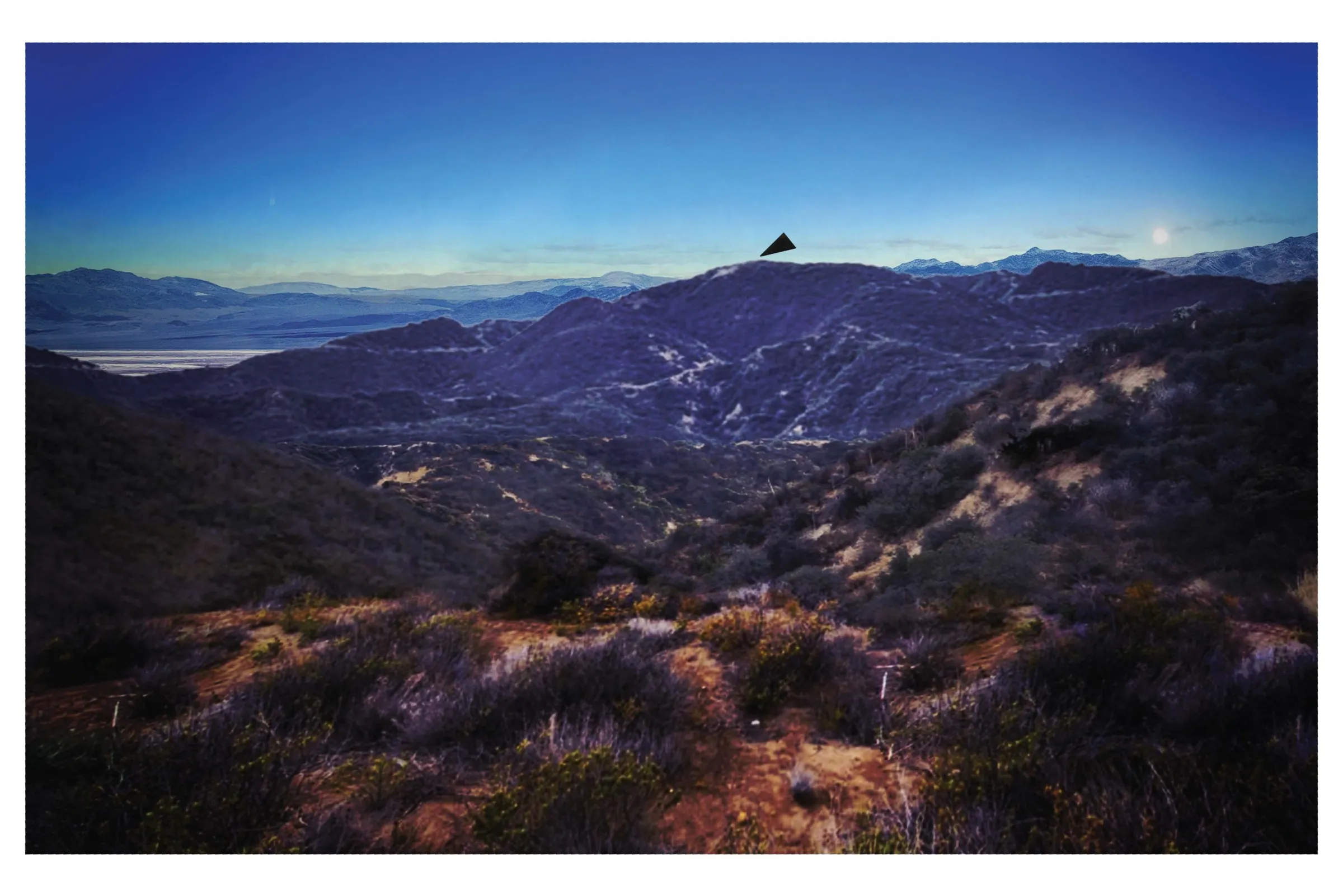
The notable items include:
-
A black triangle over a federal site, June 2026. The lead file is a memorandum for record by the All-domain Anomaly Resolution Office (AARO), the Pentagon's standing UAP office, debriefing two federal special agents and a third official at a separate observation post at what the portal calls "a sensitive national security site in the western United States." At dusk, the third official, scanning westward with long-range thermal equipment, called out a contact over a ridge; the two agents ran across the peak with binoculars and a handheld thermal monocular and watched "a matte black triangular shape of extremely low aspect ratio" — a wingspan of thirteen to fifteen feet, a fuselage of six to nine, one to two feet thick — make "a slow, controlled, perfectly vertical ascent" of two to three hundred feet over about ten seconds, hold "a stable hover" for about twenty, and then pass "from a zero-velocity state directly into high-speed horizontal flight," banking into a canyon in two to three seconds "with speed the observers described to be as fast as a fighter jet." Throughout, the memorandum records "absolute acoustic silence" and, in infrared, "a spatially uniform thermal signature across the entire airframe" with no exhaust or hot spot. A ground survey of the canyon the next morning "located no wreckage, ground scarring, or vegetation damage." The agents, the memorandum notes, have extensive experience with unmanned aircraft and said that even a small quadcopter "would have been clearly audible" from the hilltop. AARO's index entry adds the sentence that matters most: the office considers the incident to "warrant further investigation due to the close alignment of the phenomena's reported morphological features and kinematic profiles with those of other reported incidents in the western United States region." The FBI's interview record of the same two agents is released beside it, and it differs on several points discussed below.
-
The contractor's plans, 2008–2009. Release 06 published the government's side of AAWSAP — the statement of objectives, the contract, and 37 reference papers. Release 07 publishes the contractor's side: the December 2008 project management plan, four monthly reports from 2009, and a November 2010 self-assessment by Bigelow Aerospace Advanced Space Studies (BAASS), the Las Vegas firm that held the contract. The plan proposes to study "craft" or events BAASS already believed showed novel behavior rather than the academic state of the art, and it sets out nine projects. One, "Colares," asks that the DIA "contact the Brazilian Air Force by February 1, 2009 in order to secure an entire set of files, including medical records," on the 1977 events at Colares Island in northern Brazil; another recommends that, "under the premise that biological material of potentially non-human origin has been recovered," the DIA "lobby via interagency connections for access to medical samples" for BAASS forensic personnel. The plan states that BAASS advisers hold "a list of about ten individuals" who had worked on "programs involving retrieval of advanced aerospace hardware or of associated biological material," and closes: "It is imperative that physical access be obtained to actual hardware." Attached as research material from an adviser are two documents long public: the Air Materiel Command's September 23, 1947 opinion that the "flying discs" are "something real and not visionary or fictitious," and a sealed 2002 affidavit by the 1947 public information officer of Roswell Army Air Field — his name redacted in the release — stating that he saw "a couple of bodies under a canvas tarpaulin." The affidavit matches the one Walter Haut, Roswell's public information officer in 1947, signed for release after his death; it has been public since 2007. Its presence in a contractor's appendix is not a government finding, and nothing in the release treats it as one.
-
The vault, Brazil, and the data warehouse. The June 2009 monthly report records that the BAASS administrator "designed and created architectural plans for a 5000 sq.ft underground vault with 3 foot thick walls, ceiling and floor," under "15-20 feet of earth" at the Bigelow Aerospace site in North Las Vegas, to "acquire recovered hardware and biological samples from the corporate world and/or from private individuals and groups located elsewhere, including in Brazil." Occupancy was expected "subject to building permits" by late 2009 or early 2010; nothing in the release shows that the vault was built or that it ever held anything. The same report describes a ten-day deployment to Fortaleza and Sobral in Brazil, made under "strict instructions not to draw attention to the organization," which copied about seventy gigabytes of investigative material and photographed a private group's collection — including "metal fragments taken from a crash site" — that BAASS was not authorized to analyze. The earlier reports document the data warehouse, Project Capella, which by March 2009 held "234,364 unusual aerial phenomena reports" from "593 B.C. to present time," duplicates included; a purchase order with the Mutual UFO Network (MUFON) for case reports and physical samples, whose underspending BAASS answered by halving the stipend; an effort to have BAASS named the Federal Aviation Administration's reporting point for UAP; and a staff of forty-five full-time employees by June 2009, a payroll that included "Utah Ranch Security Officers." By November 2009 the report is franker: projects including classified-archive access and oral history "are on hold because BAASS currently does not have the Need to Know." The November 2010 self-assessment describes "the largest known UAP performance and behavior Data Warehouse in the world."
-
The Utah ranch, 2010. A sixty-page BAASS report documents two field deployments, in March and April 2010, to a ranch near Fort Duchesne in northeastern Utah; the ranch's name is redacted throughout, although a November 2009 monthly report in the same release carries an internal memorandum with the subject line "Skinwalker Ranch." Investigators interviewed "over twenty-five (25) people" — police officers, ranchers, business owners, Native American residents including a shaman — who reported "unidentified balls of light at close range, daytime sightings of "dog-like" creatures running on two legs, unnatural animalistic howling/screaming, "little people", prehistoric-like birds and a maggot which measured about 8-feet long." The report sets out plans to deploy sensors and plant "biosensors," and "to initiate a variety of games, puzzles, and other strategies in order to establish communication with the source/origin of reported anomalies." It also contains the result of the one physical test it describes. Hair caught on a barbed-wire fence after a resident's dogs chased what he called a "Skinwalker" was sequenced; all three fence samples carried the same domestic-dog sequence, and BAASS's own scientist concluded that the dogs on the property, which "run at will," were the likeliest source. A fourth hair, from a red-stained rock on the mesa, was a raccoon's. "The results for the samples were fairly straightforward," the scientist wrote.
-
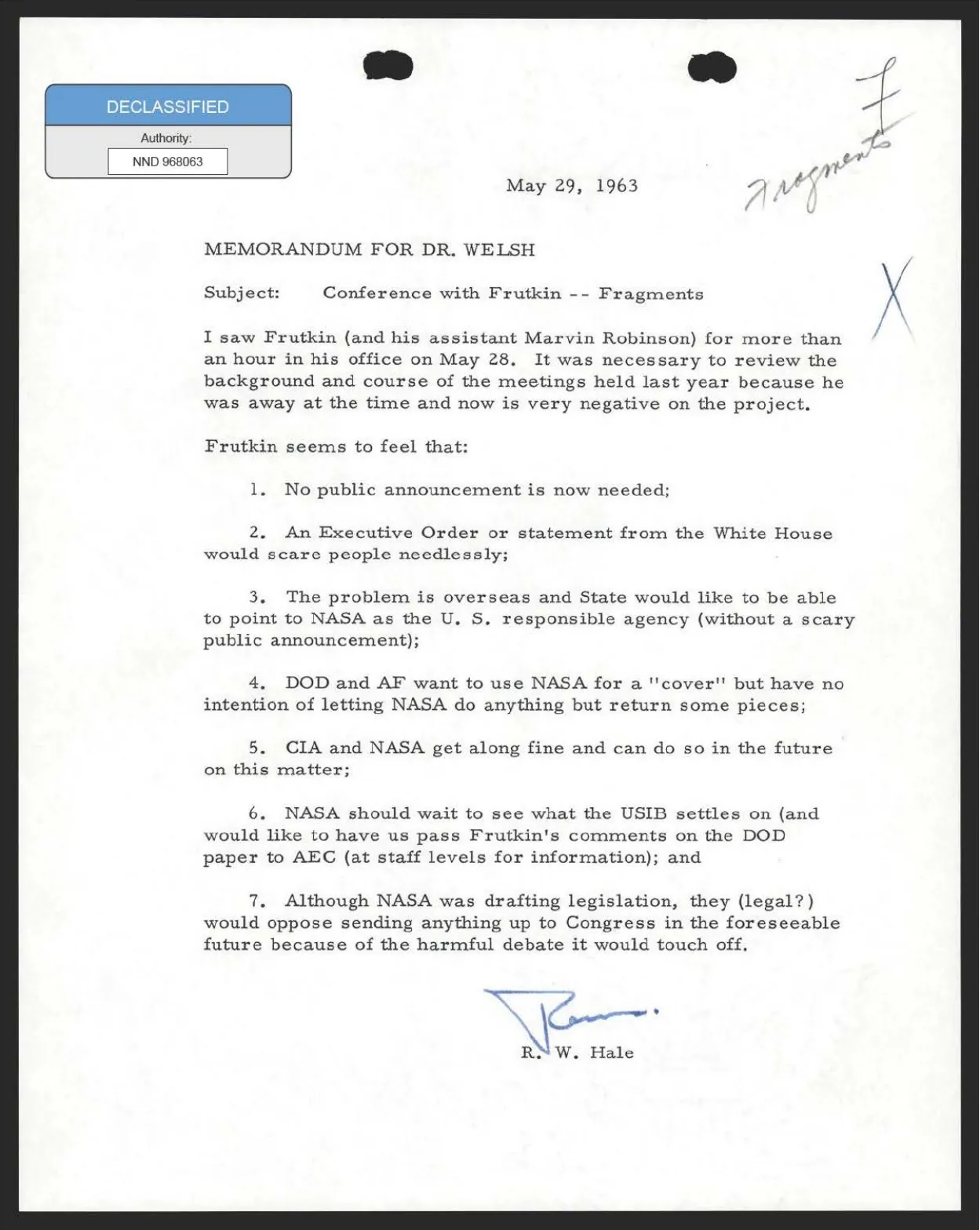
Objects that fall from space, 1962–1964. The first "USG" file is a folder from the National Security File at the Lyndon Baines Johnson Library: seventy-two pages of correspondence among the National Aeronautics and Space Council, the National Security Council staff, NASA, the CIA, and the Department of Defense on who should recover and analyze "fragments or suspected fragments from space vehicles." The drafts make NASA the public face for any foreign object that comes into U.S. possession and route the material, in a March 1963 Defense revision, to the Department of Defense "for intelligence purposes." The NSC staffer Charles E. Johnson wrote in October 1962: "It stands to reason that if we believe the satellite were hostile that we would not return it to its point of origin." The companion White House memorandum of May 29, 1963 records NASA's director of international programs, Arnold Frutkin, as "very negative on the project": in his view "DOD and AF want to use NASA for a "cover" but have no intention of letting NASA do anything but return some pieces," and a White House statement "would scare people needlessly." The folder ends without a settled policy. Neither document uses the word "UFO"; a 1964 NASA teletype in the folder sets out the public line in capitals: "UNDER NO CIRCUMSTANCES DOES THIS AGENCY (GOVERNMENT) CONJECTURE ON THE ORIGIN OF AN OBJECT."
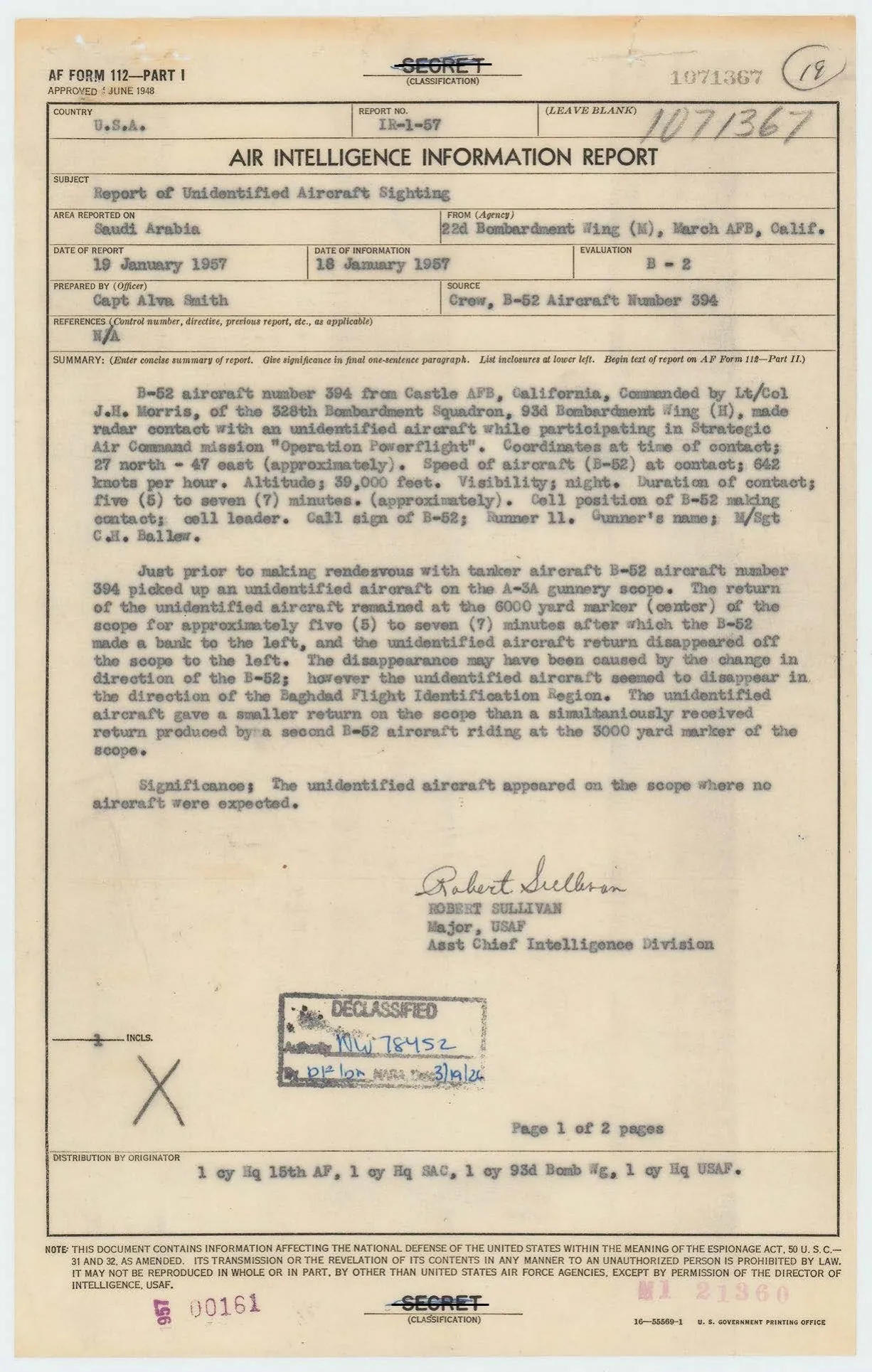
- The Air Force years, 1949–1957. Fourteen sighting files fill out the tranche. The strongest are three military reports. In January 1957 the tail-gun radar of a B-52 flying the Strategic Air Command's "Operation Powerflight" held an unidentified return over eastern Saudi Arabia for five to seven minutes at 39,000 feet and 642 knots; the report's one-line significance reads: "The unidentified aircraft appeared on the scope where no aircraft were expected." On New Year's Eve 1956 an F-86D interceptor pilot off Guam chased a blinking light in afterburner for about ten minutes while it "proceeded to turn with the aircraft," climbed over him, and circled him twice; the report concludes that unless a lighted weather balloon had malfunctioned, the object "can not be readily explained." And in November 1953 two Air Force guards at Prince George, British Columbia, watched a humming, blinking light descend to about 150 feet, hover, rise, and leave; the intelligence officer wrote "Cause unknown." The rest is thinner: an Italian professor's luminous sphere over Sardinia, lights on the Soviet side of the Bering Strait, red lights in the Berlin air corridors, a Swedish airline crew's metallic ellipse, a radar return over Morocco attributed to anomalous propagation or storks, and four files from Santa Catalina Island whose own record cards conclude "insufficient data," "Jupiter," and "probable meteor." One of them is a 1949 letter addressed to Kenneth Arnold, the pilot whose 1947 sighting gave the flying saucer its name, which reached the Air Force through the Office of Special Investigations.
- Colonel McCoy's personnel file. The longest document in the release is the final personnel record of Colonel Howard M. McCoy, who from 1946 to 1949 ran Air Force technical intelligence at Wright Field — first as deputy commanding general of the T-2 intelligence division, then as chief of the Air Materiel Command's Intelligence Department — the office under which Projects Sign and Grudge, the Air Force's first two UFO studies, were run. Lieutenant General Nathan F. Twining, who signed the 1947 "flying discs" opinion attached to the BAASS plan, rated him in October 1947: "Smart and intelligent with a good analytical mind. Knows his job but does not express himself well." The record establishes his career; it says nothing about flying discs. Some coverage of the release reported a Roswell witness affidavit in this file. There is none: the only Roswell references in its 298 pages are a 1951 order assigning a major and three nurses to Walker Air Force Base.
What this is, in plain terms
Source claim. Release 07 continues where Release 06 stopped. The sixth tranche published what the government asked AAWSAP to study; the seventh publishes what its contractor set out to do: collect sighting reports by the hundred thousand, buy them from civilian investigators, investigate a Utah ranch with a long local reputation for strange events, travel to Brazil, and — on paper — acquire and store recovered hardware and biological material. Beside that sit a federal sighting from June 2026, published within four months, and a Kennedy-era argument about what to do when something of uncertain origin falls out of the sky. The contributing roster is unchanged apart from the new "USG" label, which marks a presidential-library folder drawn from several agencies at once. The cadence held at five weeks, between the four of the early intervals and the six of the last.
Comparative observation. Much of the AAWSAP material is known in outline. Journalists and former participants have described the program's ranch work and its database in books and interviews since the program became public in 2017, and the Roswell affidavit and the 1947 Air Materiel Command opinion attached to the plan have been in print for years. What the release adds is the contractor's own paper: its monthly accounting to the government, its hiring, its spending disputes, and its stated ambitions, under official provenance. The paper is self-revealing in both directions. It shows a contractor planning a vault for "exotic material or tissue that the organization could obtain," and it shows the same contractor's scientist sequencing the "Skinwalker" hairs and reporting a domestic dog.
Three cautions attach to the headline material. First, every claim about recovered hardware, biological samples, or retrieval programs in this release is the contractor's premise, its advisers' testimony, or its plan; no document records the government or BAASS obtaining any such material, and the only physical items described — the Brazilian group's fragments — were photographed but not analyzed. Second, the 2026 triangle rests on two accounts of the same event that do not fully agree, and AARO characterizes nothing about its nature. Third, the space-fragments file concerns satellites and rocket debris; its relevance to the subject is the procedure it drafts for objects of unknown origin, and the release does not explain why it was included.
Where this sits in the Wheel of Heaven framework
The Age of Aquarius chapter treats the sequence of official UAP engagements as the first of the age's Signs of Acceleration (§IX). The first six dispatches read Releases 01–06 as the first six datable points on the disclosure curve the corpus places in the 2026–2030 window. Release 07 is the seventh.
Wheel of Heaven interpretation, marked as such. Two items carry the framework's interest. The first is the 1962–1964 fragments file. The canon's account of the Elohim is an account of visitors from elsewhere whose presence, when it is acknowledged, is acknowledged by governments — and here is a government, at the start of the space age, writing down in draft what it would do when an object of uncertain origin came into its hands: hold it for intelligence analysis, show the public a civilian agency, return it only if it seemed harmless, and decline to speculate on where it came from. The file is about Soviet and American hardware, and the corpus reads it as nothing more. It is still the clearest record yet published of how the American state planned to handle the question of origin, and its public rule — never conjecture — is the posture the corpus has watched the government hold for sixty years.
The second is the AAWSAP plan's working premise. In 2008 a Defense Intelligence Agency contractor wrote, in a deliverable to its customer, that it would proceed "under the premise that biological material of potentially non-human origin has been recovered," and asked the DIA to lobby for access to it. That a premise of this kind could be written into a government contract deliverable is a fact about the government's records. The corpus registers it and draws no conclusion from it about what was or was not recovered.
The registration stops there, because the corpus's reception posture requires it to. Under that posture — registration without enlistment — no unresolved case in this or any PURSUE release is evidence for the framework, and no case the record resolves is evidence against it. The Utah ranch report shows why the posture is needed. Its witnesses describe creatures, lights, and portals; its one laboratory test returns a dog and a raccoon; and the contractor's own staff concede, a month later in the same release, that the security officers' anecdotes "can be easily explained by (a) fraud perpetrated by the officers, (b) trespassers, (c) animals." The framework's account of the Elohim does not depend on any of it. The skeptical layer is again working in public view, this time inside the contractor's own monthly reports.
Where this sits in the broader trajectory
Wheel of Heaven interpretation, marked as such. The more consequential feature of Release 07 is the status of its lead case. Earlier tranches already reached into 2026: Release 05 published FBI interviews, recorded this year, with government special agents who described a "thermally elevated aerial object" and slow-moving objects in the western United States. What is new is AARO's own posture toward the triangle. The office has published a case it says warrants "further investigation," and it ties the case to a regional pattern — "other reported incidents in the western United States region" — that it names without describing. The index does not say whether the Release 05 interviews belong to that pattern. PURSUE is now releasing cases while the government is still working on them, and saying so, which is a different kind of disclosure from opening old files.
The program's hub entry has tracked one open edge since August: the question of whether the intelligence community's contractors — the population at the center of the 2023 congressional testimony about retrieval programs — would be brought under the disclosure channel. Release 07 does not close it. It does publish, for the first time, a contractor's own record of looking for exactly the material that testimony described, and of the list of individuals it believed could lead to it. No record in the release says what became of that search. The corpus holds both available readings open: that no such material exists to be found, which is AARO's stated finding, or that it exists beyond this program's reach.
Open question. Whether AARO's "further investigation" of the triangle reaches a published finding, and whether the western incidents it says the case resembles are released in turn, is the near-term test. The longer test is unchanged: the multi-year durability of the cadence, now seven releases over five and a half months. The corpus will track Release 08 when it appears.
Chronology
| Date | Event | Status |
|---|---|---|
| 1946, Jul – 1949, Aug | Howard M. McCoy heads Air Force technical intelligence at Wright Field, the office under which Projects Sign and Grudge run | per Release 07 (personnel record) |
| 1947, Sep 23 | Air Materiel Command opinion: the "flying discs" are "something real" | per Release 07 (attached to the BAASS plan) |
| 1949, Apr 28 | Residents of Avalon, Catalina Island, report six objects; the letter goes to Kenneth Arnold | per Release 07 |
| 1953, Nov 8 | Two Air Force guards at Prince George, British Columbia, watch a light descend to about 150 feet and hover; "Cause unknown" | per Release 07 |
| 1956, Dec 31 | An F-86D pilot chases a blinking light off Guam for about ten minutes | per Release 07 |
| 1957, Jan 18 | A B-52 on Operation Powerflight holds an unidentified radar return over Saudi Arabia | per Release 07 |
| 1962, Oct 2 | The National Aeronautics and Space Council opens interagency talks on space-vehicle fragments | per Release 07 (LBJ Library file) |
| 1963, Mar 1 | Defense revision routes foreign fragments to the Department of Defense "for intelligence purposes" | per Release 07 |
| 1963, May 29 | Space Council memorandum: NASA's Frutkin objects to serving as a "cover" | per Release 07 |
| 1973, Dec 13 | Contact between Raël and the alliance officer at Puy-de-Lassolas | per Raëlian source |
| 1977 | Reported events at Colares Island, Brazil | per Release 07 (BAASS summary) |
| 2008, Dec | BAASS project management plan: nine projects; the "premise" of recovered biological material | per Release 07 |
| 2009, Mar | Project Capella holds 234,364 sighting reports, duplicates included | per Release 07 |
| 2009, May – Jun | BAASS deployment to Fortaleza and Sobral, Brazil | per Release 07 |
| 2009, Jun | Plans drawn for a 5,000-square-foot underground vault in North Las Vegas | per Release 07 |
| 2009, Aug 3 | Round-the-clock BAASS surveillance of the Utah ranch begins | per Release 07 |
| 2010, Mar – Apr | BAASS field deployments to the Utah ranch; hair samples return dog and raccoon | per Release 07 |
| 2010, Nov 23 | BAASS self-assessment: "the largest known UAP performance and behavior Data Warehouse in the world" | per Release 07 |
| 2017, Dec 16 | New York Times reveals the Advanced Aerospace Threat Identification Program | confirmed |
| 2023, Jul 26 | Congressional UAP hearing; Grusch, Graves, Fravor testimony | confirmed |
| 2026, May 8 | PURSUE Release 01 posted at war.gov/UFO | previous dispatch |
| 2026, May 22 | PURSUE Release 02 posted at war.gov/UFO | previous dispatch |
| 2026, Jun | Federal agents observe a black triangle at a sensitive site in the western United States | per Release 07 (AARO, FBI) |
| 2026, Jun 12 | PURSUE Release 03 posted at war.gov/UFO | previous dispatch |
| 2026, Jul 10 | PURSUE Release 04 posted at war.gov/UFO | previous dispatch |
| 2026, Jul 31 | ODNI issues preliminary PURSUE guidance; contractor coverage deferred | confirmed |
| 2026, Aug 7 | PURSUE Release 05 posted at war.gov/UFO | previous dispatch |
| 2026, Sep 14 | Department of War issues a targeted legal waiver for disclosures to PURSUE | confirmed |
| 2026, Sep 18 | PURSUE Release 06 posted at war.gov/UFO | previous dispatch |
| 2026, Oct 23 | PURSUE Release 07 posted at war.gov/UFO — 28 documents: the June 2026 triangle, the BAASS operating record, the space-fragments file | this dispatch |
| 2026 → ongoing | Next release "actively" in work, per the Department | scheduled |
Source tensions and unresolved issues
-
The unresolved-case framing remains in force. No Release 07 item is characterized as confirmed non-conventional, and the corpus does not so characterize any. AARO's index wraps every report in the same caution: descriptive language "reflects the reporter's subjective interpretation at the time of the event."
-
The two accounts of the triangle disagree. AARO's memorandum gives the time as 2023 local and describes about thirty-two seconds of observation — ten of ascent, twenty of hover, two to three of flight. The agents' own co-signed statement in the FBI record gives "approximately 1923 hours," a total duration of "approximately three seconds," a wingspan of nine to fifteen feet against AARO's thirteen to fifteen, and a climb of about 200 feet. The FBI statement also describes the object as "most resembling a delta wing drone," calls it an "unmanned aerial system," and reports that it "appeared hotter than ambient temperature" — where some press coverage, reading AARO's "no localized thermal concentrations," reported no heat signature at all. The corpus attributes each figure to its document and asserts neither.
-
The released memorandum is shorter than its index entry. AARO's index describes observations "over two days," "a secondary observation on the following evening," and "associated analytic support material." The released file is three pages and covers only the first evening and the next morning's ground survey. Whatever the second observation was, it is not in the release.
-
"Skinwalker" is the press's word more than the report's. The Utah ranch report redacts the ranch's name everywhere, does not name the program it was written for, and never attaches "Skinwalker" to the property; the name appears unredacted only in a subject line in the November 2009 monthly report and as a local place name, "Skinwalker Ridge." The report also contradicts itself on the number of cameras deployed and still describes its hair samples as "currently undergoing scientific DNA analysis" in a finding printed ahead of the laboratory results that close the same document.
-
The vault is a design. Press accounts reported the underground vault as a fact of the program. The June 2009 report describes architectural plans "subject to building permits"; no later document in the release mentions its construction.
-
Two numbers are missing, and some titles overstate. The release runs DOW-UAP-D155 to D181 but omits D165 and D172 — the latter falling between the June and November 2009 monthly reports — without explanation. Four Catalina Island files are titled "Unresolved UAP Report," but their own record cards conclude "insufficient data," no evaluation, "Astronomical (JUPITER)," and "probable meteor." The index dates the Prince George sighting to November 13, 1953, the date of the report; the report itself gives November 8.
-
The Roswell claims need sorting. Some coverage reported a Roswell witness affidavit inside Colonel McCoy's personnel file; the file contains none. The release does contain a Roswell affidavit — as an exhibit in the 2008 BAASS plan, supplied by an adviser, describing events the affiant said he witnessed in 1947, and already public since 2007. It is a contractor's research material and the release presents it as nothing else.
-
The cadence is now seven instances. Intervals of two, three, four, four, six, and five weeks. A single small tranche is a datum, not a trend, and the multi-year durability the framework treats as the load-bearing test remains untested. The next data point is Release 08.
— Filed October 31, 2026, by the Wheel of Heaven editorial desk.
Canon touched
Sources
- Department of War Publishes Seventh Release of Unidentified Anomalous Phenomena Files on WAR.GOV/UFO U.S. Department of War (2026-10-23)
- PURSUE portal — Release 07 documents, with the portal's file index and AARO descriptions U.S. Department of War (2026-10-23)
- Triangular UAP AARO Memorandum for Record, 2026 (DOW-UAP-D176) — primary witness debrief All-domain Anomaly Resolution Office (2026)
- FD-302, Unidentified Aerial Object Observation Report, 2026 (FBI-UAP-D043) — primary interview record Federal Bureau of Investigation (2026)
- BAASS Project Management Plan, December 2008 (DOW-UAP-D168) — primary program record Bigelow Aerospace Advanced Space Studies, via the Defense Intelligence Agency (2008)
- BAASS Monthly Report, June 2009 (DOW-UAP-D171) — primary program record Bigelow Aerospace Advanced Space Studies, via the Defense Intelligence Agency (2009)
- Utah Ranch Investigation Report, April 2010 (DOW-UAP-D174) — primary field report Bigelow Aerospace Advanced Space Studies, via the Defense Intelligence Agency (2010)
- Memorandum on Interagency Coordination for the Recovery of Foreign Materiel, May 1963 (EOP-UAP-D002) — primary memorandum National Aeronautics and Space Council, Executive Office of the President (1963)
- Interagency Correspondence Concerning Space Fragments, 1962–1964 (USG-UAP-D002) — primary correspondence file Lyndon Baines Johnson Library, National Security File (1962–1964)
- Air Intelligence Information Report, Saudi Arabia, 1957 (DOW-UAP-D155) — primary report U.S. Air Force, 22d Bombardment Wing (1957)
- Seventh Release of files on Unidentified Anomalous Phenomena (UAP) — Project Capella Detailed Leonard David's Inside Outer Space (2026-10-23)
- New UFO Files Released Show Bizarre Drawings of Alleged Aliens Newsweek (2026-10-23)
- DOD Releases Seventh Batch of Declassified UAP Files MeriTalk (2026-10-27)
Read as Agent: